
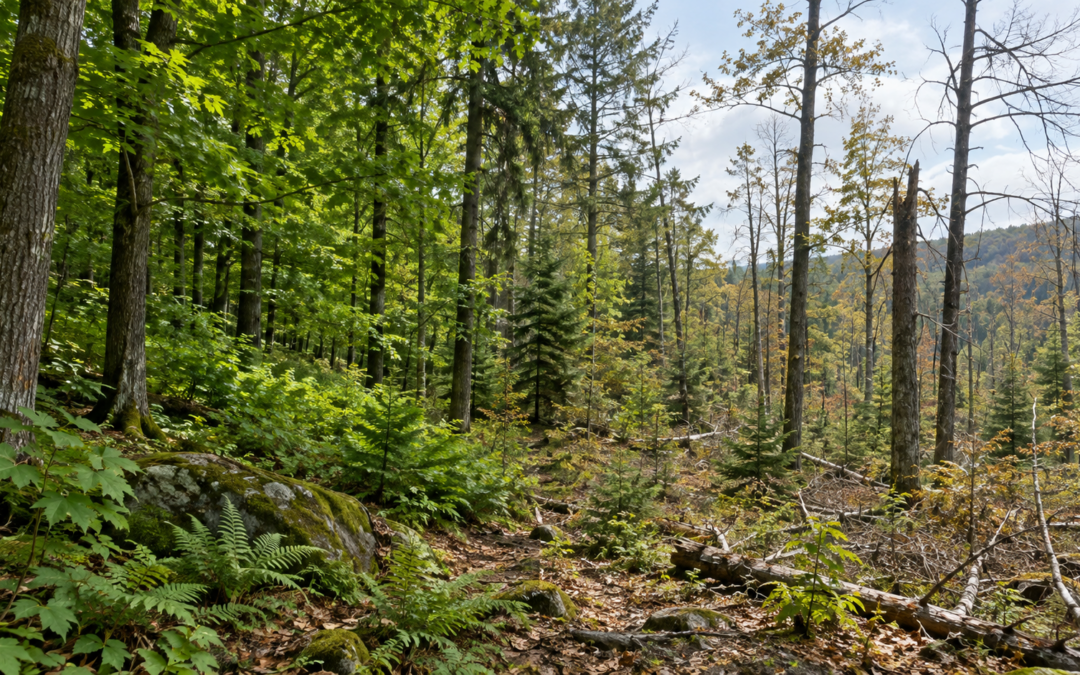
A forest can look strong and permanent, but the health of its trees is constantly influenced by biological and environmental pressures.
Fungi, bacteria, viruses, nematodes, and other pathogens can infect roots, leaves, bark, and vascular tissues. These infections may interfere with a tree’s ability to transport water and nutrients, photosynthesize, grow, and defend itself.
Tree disease does not always remain an individual-tree problem.
When disease becomes widespread, particularly when an important or dominant tree species is affected, the consequences can extend throughout the forest. Tree mortality can alter canopy structure, wildlife habitat, plant communities, nutrient cycling, and other ecological processes.
Understanding tree diseases and forest ecosystem decline therefore means looking beyond individual symptoms and considering how disease interacts with drought, pests, biodiversity, regeneration, and the surrounding environment.
Diseases Can Weaken Individual Trees
Tree diseases can interfere with several essential biological functions.
Some pathogens damage leaves and reduce photosynthesis. Others attack roots and limit water or nutrient uptake. Diseases affecting bark or vascular tissues may interfere with the movement of water and nutrients between roots and the tree canopy.
Possible signs of declining tree health can include:
- Leaf discoloration
- Premature leaf loss
- Branch dieback
- Abnormal growth
- Bark lesions or damage
- Cankers
- Fungal growth
- Reduced growth
- Crown thinning
However, these symptoms do not always identify a specific disease by themselves.
Similar symptoms can result from drought, insects, nutrient problems, root damage, weather events, or combinations of several stresses.
For that reason, observing symptoms is usually the beginning of diagnosis rather than the final answer.
Pathogens Can Spread Through Forests
Forest pathogens can move in several ways.
Depending on the organism involved, disease may spread through wind, rain or water, soil, insects, animals, infected roots, or diseased plant material.
Human activity can also move harmful organisms far beyond their natural range.
Plants, wood, firewood, soil, equipment, vehicles, and other materials can transport insects or pathogens into areas where they were not previously established.
This is particularly concerning with invasive pests and diseases.
Once introduced into a suitable environment, some organisms can spread over large areas and become extremely difficult to control.
Preventing accidental movement of invasive organisms is therefore an important part of protecting forest health.
Tree Mortality Changes Forest Structure
Tree mortality is a natural part of forest ecology.
Individual trees eventually die because of age, competition, storms, drought, disease, insects, or other causes.
Problems can become more significant when mortality increases substantially across a forest or disproportionately affects an important tree species.
When enough canopy trees die, openings develop in the forest.
These canopy gaps allow more sunlight to reach the understory and forest floor. They can also alter local temperature, humidity, wind exposure, and soil moisture.
Those changes may favor some organisms while creating less suitable conditions for others.
New plants can establish in the openings, existing vegetation may expand, and wildlife may respond to changes in food and shelter.
The result is that widespread tree mortality can gradually reshape the structure and composition of a forest.
Disease Can Affect Forest Biodiversity
Different forest organisms depend on trees in different ways.
Some animals eat particular fruits, seeds, leaves, or bark.
Others nest in cavities, branches, or dense tree canopies.
Fungi, lichens, insects, microorganisms, birds, and mammals may depend directly or indirectly on particular tree species or forest structures.
If disease severely reduces an important tree species, organisms associated with that species may also be affected.
The ecological consequences may extend well beyond the pathogen and the tree it infects.
This is one reason maintaining tree and plant diversity can be important for forest resilience.
A more diverse forest may contain multiple species performing similar ecological functions, although the effect of diversity depends greatly on the particular forest and disturbance involved.
Drought Can Increase Disease Stress
Disease rarely acts in isolation.
Environmental stress can influence how well trees tolerate or resist pathogens.
Drought is particularly important.
Trees experiencing prolonged water shortages may have difficulty maintaining normal physiological processes. Severe or prolonged drought can restrict growth and affect some of the mechanisms trees use to defend themselves.
At the same time, changing temperature and moisture conditions may affect the organisms attacking trees.
Some pathogens and insect pests may become less successful under certain conditions, while others may survive, reproduce, or spread more effectively.
For this reason, forest decline may result from several interacting pressures rather than one simple cause.
A tree might experience drought stress, insect damage, and disease at the same time.
Understanding these interactions is essential when evaluating forest health.
Dead Trees Still Have Ecological Functions
A tree does not stop contributing to a forest immediately after it dies.
Standing dead trees—often called snags—can provide perching, nesting, roosting, and shelter opportunities for wildlife.
Eventually, some dead trees fall to the ground.
Fallen logs and other woody material can become habitat for insects, fungi, microorganisms, mosses, and other organisms.
As the wood decomposes, materials contained within it gradually become part of the forest floor and nutrient cycle.
Deadwood is therefore a natural component of many forest ecosystems.
This does not mean that every dead tree should always be left standing. Safety hazards, wildfire considerations, invasive pests, recreational use, and forest-management objectives can all affect deadwood management decisions.
Ecologically, however, tree mortality is not simply a loss. Dead and decomposing trees continue participating in forest processes.
Forest Recovery Depends on Regeneration
What happens after trees die can be just as important as the mortality itself.
When canopy trees are lost, successful forest recovery depends partly on whether new vegetation can establish and survive.
Seedlings may emerge from seeds already present in the soil, seeds dispersed from nearby trees, or surviving young trees already growing beneath the canopy.
If suitable seedlings survive and enough species diversity remains, the forest may gradually rebuild its canopy.
Recovery can become more difficult when the disease continues attacking young trees of susceptible species.
Other factors can also influence regeneration, including drought, browsing animals, competing vegetation, fire, soil conditions, invasive species, and the availability of viable seeds.
Forest recovery is therefore a process rather than an immediate response.
Invasive Pests and Diseases Can Increase Forest Risk
Native forests have developed alongside many native insects and microorganisms over long periods of time.
Introduced organisms can present a different challenge.
When an invasive pest or pathogen reaches a new region, susceptible trees may have limited natural resistance. The organism may also encounter fewer natural enemies.
Human movement of materials can accelerate this process.
Firewood, nursery plants, soil, equipment, vehicles, and other materials can unintentionally transport pests and pathogens.
Simple preventive measures can therefore play an important role.
Following local plant-health regulations, avoiding unnecessary movement of firewood, inspecting plant materials, and cleaning equipment when appropriate can help reduce the risk of moving harmful organisms between locations.
Monitoring Can Help Detect Disease Early
Regular forest monitoring can help identify changes before they become widespread.
Useful observations may include:
- Unusual leaf discoloration
- Crown thinning
- Premature leaf loss
- Branch dieback
- Bark abnormalities
- Unusual fungal growth
- Clusters of recently dying trees
- Changes in regeneration
- Signs of insect activity
A single abnormal tree does not necessarily indicate a major forest disease.
Patterns are particularly important.
If similar symptoms suddenly appear across multiple trees, continue spreading, or occur in clusters, closer investigation may be appropriate.
Accurate diagnosis is also important because symptoms caused by insects, drought, nutrient deficiencies, mechanical injuries, herbicides, pathogens, and other stresses can sometimes look similar.
Foresters, arborists, plant pathologists, extension professionals, or appropriate government agencies may be able to help identify unusual or potentially serious problems.
Protecting Forest Health Requires More Than Treating Disease
Managing forest disease is rarely as simple as eliminating a pathogen.
A healthy forest depends on many interacting factors.
Tree species diversity, age structure, genetics, water availability, soil conditions, climate, insects, microorganisms, wildlife, fire, and human management can all influence forest resilience.
Forest-health strategies may therefore involve preventing invasive organisms from entering new areas, monitoring tree health, encouraging appropriate regeneration, maintaining suitable diversity, and reducing avoidable environmental stresses.
Different forests require different management strategies.
A commercial plantation, urban forest, old-growth ecosystem, conservation area, and recently disturbed forest will not necessarily have the same management objectives.
The goal should be to understand the ecological context and manage risks accordingly.
Conclusion
Tree diseases are a natural part of forest ecosystems, but widespread or severe disease can contribute to much larger ecological changes.
Pathogens can damage leaves, roots, bark, and vascular tissues. When susceptible trees are weakened or killed, forest canopy structure can change, wildlife habitat can be altered, and organisms that depend on particular tree species may also be affected.
Drought and other environmental stresses can further complicate these interactions.
At the same time, tree death is not the end of the ecological process.
Standing and fallen deadwood can provide habitat, decomposers recycle organic material, and new seedlings may eventually occupy openings created by lost trees.
The long-term health of a forest therefore depends not only on preventing disease but also on maintaining the ecological processes that allow forests to adapt and regenerate.
Regular monitoring, preventing the unnecessary spread of invasive organisms, maintaining appropriate forest diversity, and supporting natural regeneration can all contribute to healthier and more resilient forest ecosystems.
Learn More About Forest Ecology and Environmental Stewardship
Understanding how forests respond to disease, drought, biodiversity loss, and other pressures is an important part of responsible environmental management.
The Ecolonomics Action Team (EAT Community) brings together people interested in environmental sustainability, regenerative systems, natural-resource management, and environmentally responsible business.
Visit https://www.eatcommunity.com/ to explore more ideas and educational resources related to forest ecology and environmental stewardship.
Sources & Further Reading
FAO — Forest Health and Protection Overview
Forest Health and Protection Overview
Covers forest health, tree mortality, pathogens, drought, fire, floods, and other biotic and abiotic disturbances.
FAO — Climate Change and Forest Health
Climate Change and Forest Health
Useful for the sections on drought, changing precipitation, tree stress, and how climate conditions affect pests and pathogens.
FAO — Forest Pests, Sustainable Forest Management Toolbox
Forest Pests Module
Provides information on insects, fungi, bacteria, viruses, nematodes, invasive organisms, and forest-pest management.
USDA APHIS — Hungry Pests: Stop Invasive Plant Pests
USDA Hungry Pests
Particularly useful for your section explaining how invasive pests and diseases can spread through firewood, plants, vehicles, equipment, and other materials.
Recent Comments