
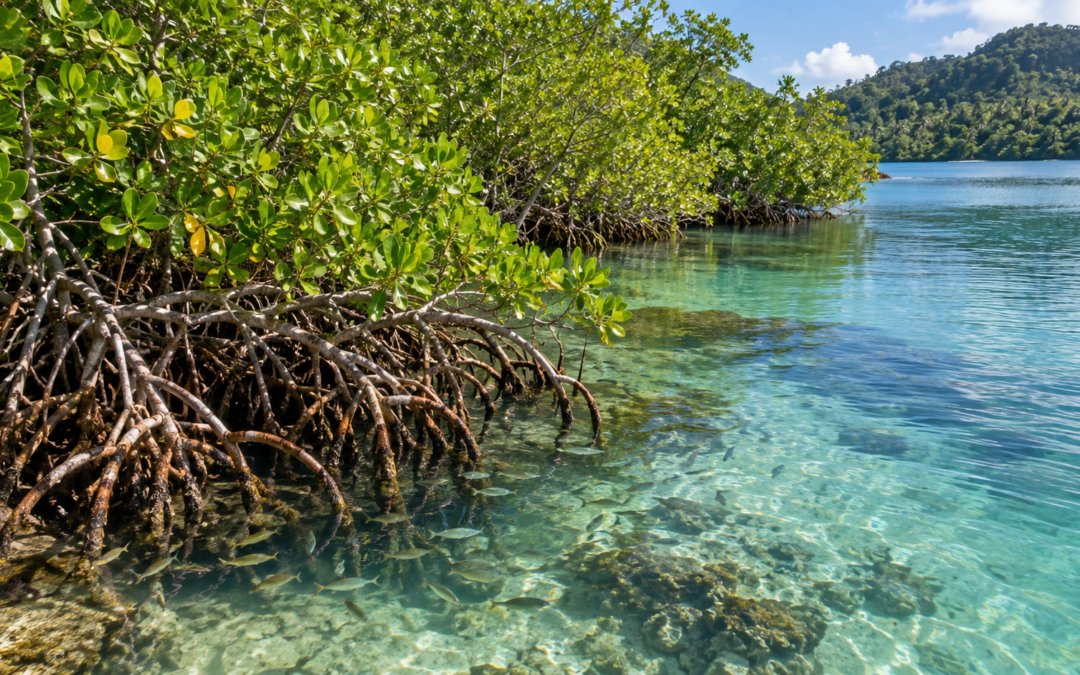
Along tropical and subtropical coastlines around the world, mangrove forests occupy a unique space between land and sea.
These forests are made up of salt-tolerant trees and shrubs capable of surviving in tidal environments where many other plants cannot.
Their roots may be submerged during high tide and exposed again when the water recedes.
That unusual environment makes mangrove forests some of the most distinctive—and valuable—coastal ecosystems on Earth.
Mangroves provide habitat for fish, crabs, birds, reptiles, and other wildlife. Their roots help stabilize sediments, their vegetation can reduce wave energy, and their soils can store substantial amounts of carbon.
They also form important ecological connections among rivers, estuaries, seagrass beds, coral reefs, wetlands, and open coastal waters.
Understanding the relationship between mangrove forests and coastal ecosystems helps explain why protecting existing mangroves and restoring degraded areas has become an important conservation priority.
Mangroves Provide Wildlife Habitat
Mangrove forests create complex three-dimensional habitats.
Above the water, their branches and canopies provide nesting, resting, and feeding areas for birds and other wildlife.
Below the surface, tangled root systems create protected spaces for fish, crabs, shrimp, mollusks, and many other organisms.
Young fish can use these root systems as nursery habitat before moving into larger estuaries, seagrass beds, coral reefs, or open coastal waters.
The dense roots can provide protection from larger predators while also supporting food webs based on organic material, algae, microorganisms, and small invertebrates.
Mangroves therefore function as far more than coastal vegetation.
They form living habitat networks linking terrestrial and marine ecosystems.
Mangrove Roots Help Reduce Coastal Erosion
Mangrove roots are especially important along shorelines.
Their complex root systems interact with tides, waves, currents, and sediment.
Roots can slow moving water and encourage suspended sediment to settle.
Over time, this can help stabilize parts of the shoreline.
Mangroves can also help reduce the direct removal of soil and sediment by waves and currents.
This does not mean mangroves can completely stop erosion.
Coastal erosion is influenced by storms, wave exposure, sediment supply, sea-level change, shoreline geology, currents, and human development.
However, healthy mangrove forests can form an important component of natural shoreline protection.
Mangroves Reduce Wave Energy
A dense mangrove forest creates physical resistance as water moves through roots, trunks, and vegetation.
This friction can reduce wave energy before it reaches inland areas.
The amount of protection depends on several factors, including:
- Width of the mangrove forest
- Tree density
- Root structure
- Species composition
- Wave height
- Water depth
- Storm intensity
- Coastal topography
A wide, healthy mangrove belt may provide greater protection than a narrow or heavily degraded stand.
During severe storms, mangroves cannot eliminate flooding or storm-surge risk.
But they can be one layer of coastal defense, particularly when combined with responsible land-use planning and other forms of protection.
Mangroves Store Blue Carbon
Mangroves also play an important role in the global carbon cycle.
Like other plants, mangrove trees absorb carbon dioxide from the atmosphere through photosynthesis.
Carbon becomes stored in:
- Trunks
- Branches
- Leaves
- Roots
- Dead organic material
- Coastal sediments
The waterlogged soils beneath mangrove forests are particularly important.
Because these soils often contain little oxygen, decomposition can occur relatively slowly.
As a result, organic carbon can accumulate and remain stored in mangrove sediments for long periods.
This type of stored coastal carbon is often called blue carbon.
When mangrove forests are cleared or their soils are heavily disturbed, some of that stored carbon can be released.
Protecting mangroves therefore has value both for coastal ecosystems and for climate mitigation.
Mangroves Support Fisheries
Mangroves and fisheries are closely connected in many coastal regions.
Fish, shrimp, crabs, shellfish, and other organisms use mangrove habitats during different parts of their life cycles.
Some species spend their juvenile stages among mangrove roots before moving into other marine environments.
Others depend on mangrove-associated food webs.
This means that losing mangrove habitat can have consequences beyond the forest itself.
Nearby fisheries may be affected when nursery grounds, food resources, and habitat connectivity are reduced.
Protecting mangroves can therefore support both biodiversity and coastal livelihoods.
Mangroves Can Influence Coastal Water Quality
Mangrove ecosystems can affect the movement of sediment, nutrients, and organic material between land and coastal waters.
As runoff moves through mangrove areas, roots and sediments may trap some suspended particles.
Mangrove soils and microorganisms can also influence nutrient cycling.
This can reduce the amount of some materials reaching nearby marine environments.
However, mangroves should not be treated as natural treatment plants capable of removing unlimited pollution.
Excessive nutrients, industrial contaminants, sewage, plastics, oil, and other pollutants can damage the mangrove ecosystem itself.
Healthy mangroves may help regulate certain materials, but preventing pollution at its source remains essential.
Mangroves Connect Coastal Ecosystems
Mangroves rarely function as isolated habitats.
They are often part of larger coastal landscapes that include:
- Rivers
- Estuaries
- Wetlands
- Seagrass beds
- Coral reefs
- Lagoons
- Coastal forests
- Open marine waters
Animals move among these habitats.
Water transports sediments and nutrients between them.
Some fish may spend their juvenile stages in mangroves before moving into seagrass meadows or coral reefs.
Birds may move between mangrove forests and inland wetlands.
Sediment delivered by rivers may help maintain mangrove shorelines.
Because these systems are connected, damage to mangroves can influence other coastal habitats.
Likewise, damage upstream can affect the mangroves downstream.
Mangroves Support Coastal Biodiversity
Mangrove ecosystems support species from both terrestrial and aquatic environments.
Birds may nest in tree canopies.
Reptiles may use mudflats and waterways.
Fish and crustaceans occupy submerged roots.
Insects, fungi, and microorganisms participate in decomposition and nutrient cycling.
This combination creates unusually diverse ecological conditions.
The importance of mangroves is not simply the number of species present.
It is also the variety of ecological roles they support.
Predators, grazers, decomposers, filter feeders, pollinators, and other organisms all contribute to the functioning of mangrove food webs.
Mangrove Loss Can Affect Entire Coastal Systems
Mangrove forests face a wide range of pressures.
These include:
- Coastal development
- Aquaculture expansion
- Agriculture
- Roads and infrastructure
- Tourism development
- Pollution
- Overharvesting
- Changes in river flow
- Sea-level rise
- Changing rainfall patterns
- Extreme weather
Clearing mangroves can remove habitat and expose coastal soils.
Changes upstream can reduce sediment supplies or alter freshwater flow.
Sea-level rise can create another challenge.
Mangroves may naturally migrate inland as sea level changes, but buildings, roads, seawalls, and other infrastructure can prevent that movement.
This process is sometimes called coastal squeeze.
For long-term mangrove conservation, maintaining space for future landward migration may therefore be important.
Aquaculture Can Be Both a Threat and an Opportunity
Aquaculture has historically contributed to mangrove loss in some regions where forests have been cleared for ponds.
Poorly designed coastal aquaculture can fragment habitat, alter water flows, and reduce ecosystem functions.
However, aquaculture and mangrove conservation do not necessarily have to be incompatible.
Better site selection, restoration, improved wastewater management, and integrated coastal planning can reduce impacts.
Some projects are also exploring systems that combine aquaculture production with mangrove protection or restoration.
The key is to treat mangroves as functioning ecosystems rather than unused coastal land.
Climate Change Adds New Pressures
Climate change creates additional challenges for mangrove forests.
Sea levels are rising.
Storm patterns may change.
Rainfall and freshwater flows may shift.
Higher temperatures can influence species distributions and ecosystem processes.
Mangroves can sometimes adapt by accumulating sediment or migrating inland.
But their ability to do so depends on local conditions.
Where shorelines are heavily developed, there may be nowhere for mangrove forests to move.
Protecting adjacent land and maintaining natural water and sediment flows can therefore become part of climate adaptation planning.
Protecting Existing Mangroves Should Come First
Mangrove restoration receives considerable attention, but protecting healthy existing forests is often more effective than destroying them and attempting to recreate them later.
Mature mangrove ecosystems already contain:
- Established root networks
- Stored carbon
- Wildlife habitat
- Natural hydrology
- Developed soils
- Microbial communities
- Connected food webs
Once these systems are severely disturbed, restoring them can be difficult.
Successful restoration requires more than planting seedlings.
Hydrology, elevation, tidal flow, salinity, sediment movement, wave exposure, and site history all need to be considered.
In some places, restoring natural tidal conditions may allow mangroves to return without extensive planting.
Protecting and Restoring Mangroves
Effective mangrove conservation can include several approaches.
These may involve:
- Protecting existing healthy forests
- Restoring natural tidal flows
- Reducing unnecessary clearing
- Improving coastal land-use planning
- Controlling pollution
- Protecting freshwater and sediment flows
- Restoring degraded habitat
- Allowing space for inland migration
- Working with coastal communities
- Managing fisheries sustainably
- Reducing damaging infrastructure development
Local communities are especially important.
Many people living near mangroves depend on them for fisheries, food, fuel, coastal protection, tourism, and other livelihoods.
Conservation strategies are often more durable when local communities have meaningful roles in management and decision-making.
Mangroves Are Natural Infrastructure
One useful way to think about mangrove forests is as natural coastal infrastructure.
Engineered seawalls and barriers are designed to reduce wave energy and protect shorelines.
Mangrove forests can provide some similar functions while simultaneously supporting wildlife, fisheries, carbon storage, recreation, and water-quality processes.
That does not mean mangroves can replace engineered infrastructure everywhere.
High-risk areas may still require seawalls, levees, flood barriers, or other protection.
But in many locations, combining natural ecosystems with responsible engineering can create more resilient coastal protection strategies.
Conclusion
Mangrove forests are among the most valuable ecosystems found along tropical and subtropical coastlines.
Their roots stabilize sediment and provide nursery habitat.
Their vegetation can reduce wave energy.
Their soils store large quantities of blue carbon.
They support fisheries, wildlife, nutrient cycling, and connections among rivers, wetlands, seagrass beds, coral reefs, and coastal waters.
Mangroves can also contribute to water-quality regulation and shoreline protection.
But these benefits depend on healthy, functioning ecosystems.
Coastal development, pollution, aquaculture expansion, infrastructure, altered water flows, and climate change can all place mangrove forests under pressure.
Protecting existing mangroves should therefore be a priority.
Where forests have already been degraded, restoration can also play an important role—but restoration needs to address hydrology, sediment conditions, tidal movement, and long-term space for the ecosystem to adapt.
Healthy mangrove forests benefit far more than the trees themselves.
They support entire coastal landscapes—and the communities that depend on them.
Learn More About Coastal Ecosystem Conservation
Mangrove conservation demonstrates how protecting natural ecosystems can simultaneously support biodiversity, climate resilience, fisheries, coastal communities, and economic activity.
The Ecolonomics Action Team (EAT Community) brings together people interested in environmental restoration, sustainable agriculture, aquaculture, conservation, and environmentally responsible business.
Visit https://www.eatcommunity.com/ to learn more about practical strategies for protecting and restoring natural ecosystems.
Sources & Further Reading
UNEP — Mangrove Forests
Mangrove Forests — UNEP
UNEP describes mangroves as highly carbon-rich ecosystems whose protection and restoration supports biodiversity, climate adaptation, coastal communities, and thousands of species. UNEP – UN Environment Programme
UNEP — Why Protecting & Restoring Blue Carbon Ecosystems Matters
Why Blue Carbon Ecosystems Matter — UNEP
This is especially useful for the sections on carbon storage, fisheries, water quality, flooding, storms, and mangrove threats. UNEP – UN Environment Programme
NOAA Fisheries — Protecting Coastal Blue Carbon Through Habitat Conservation
Protecting Coastal Blue Carbon — NOAA Fisheries
NOAA explains how mangroves and other coastal habitats store carbon in vegetation and soils while also providing nursery habitat and protection from storms. NOAA Fisheries
Recent Comments