
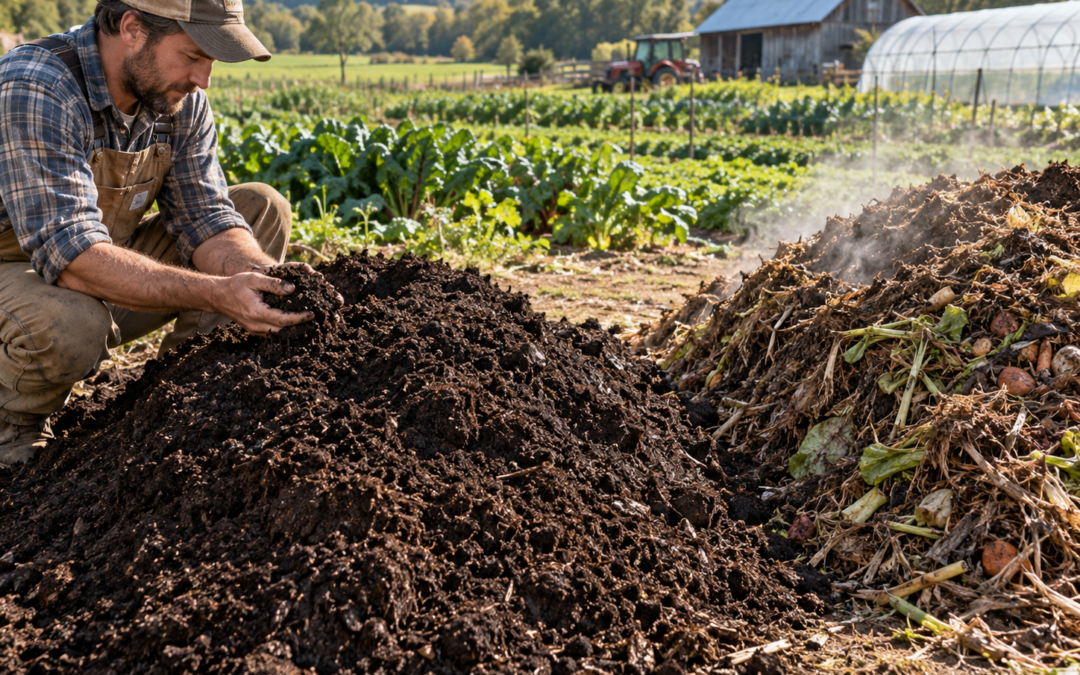
Compost does more than add organic matter to soil. Its value depends heavily on how completely the original materials have decomposed and stabilized before application. Mature compost can improve soil structure, support microbial activity, and release nutrients gradually, while immature compost may continue decomposing rapidly after application and interfere with plant growth.
This distinction matters because compost does not behave like a soluble fertilizer. Oregon State University Extension notes that more than 95% of the nitrogen in most composts is organically bound rather than immediately plant-available. Soil microorganisms must gradually convert that organic nitrogen into forms plants can use, which means compost maturity, carbon-to-nitrogen ratio, moisture, temperature, and soil conditions all influence nutrient release.
Mature Compost Is Stable Enough for Plant Use
Composting is driven by bacteria, fungi, and other microorganisms that break down leaves, crop residues, manure, food waste, and other organic materials. During active decomposition, microbial activity produces heat as easily decomposed compounds are consumed. As the supply of those materials declines, the pile cools and enters a curing stage in which the compost becomes more stable.
Maturity is not determined by appearance alone, although finished compost is often dark, crumbly, and earthy-smelling. Cornell guidance explains that mature compost should remain near ambient temperature for several days under suitable moisture and oxygen conditions, indicating that rapid microbial decomposition has slowed. A pile that heats strongly again after being moistened may still be biologically unstable.
Laboratory measurements provide a more reliable assessment. Oregon State University Extension notes that mature compost has a low decomposition rate, limited potential to inhibit plant growth, and relatively little impact on soil nitrogen. The same guidance reports that ammonium concentrations above 500 parts per million can indicate immature compost, especially when ammonium greatly exceeds nitrate.
Nutrients Are Released Gradually, Not All at Once
Compost contains nitrogen, phosphorus, potassium, sulfur, and micronutrients, but only part of those nutrients becomes available to crops immediately. Microorganisms continue decomposing the organic fraction after compost is added to the soil, slowly releasing nutrients through mineralization. This is why compost is better viewed as a soil amendment with nutrient value rather than a direct replacement for conventional fertilizer in every situation.
Oregon State University estimates that compost with a carbon-to-nitrogen ratio of 10 to 20 typically releases about 5% of its total nitrogen during the first growing season. Compost with a ratio below 10 may release about 10% to 20% of its total nitrogen during that first season, while materials with ratios above 20 may temporarily tie up soil nitrogen as microbes continue decomposition.
Long-term release is also important. OSU reports that approximately 3% to 5% of compost nitrogen may mineralize annually during years two through five following a high-rate application. This slow release can support soil fertility over several seasons, but farmers still need soil and compost tests to determine whether additional fertilizer is needed for a specific crop.
Immature Compost Can Stress Plants
Immature compost can contain ammonia, volatile organic acids, and other compounds produced during incomplete decomposition. These substances may inhibit seed germination, damage young roots, or create odors. Microorganisms can also compete with crops for available nitrogen if the material contains a large amount of undecomposed carbon.
University of California guidance describes immature compost as having a significant potential to inhibit plant growth and affect nitrogen availability in soil. Mature compost, by contrast, has a low decomposition rate and much less potential to interfere with plant growth. This distinction is especially important when compost is applied close to planting or used around seedlings.
Seed-germination tests provide one practical way to assess phytotoxicity. University of California Cooperative Extension explains that a germination index above 80% generally indicates mature compost with relatively low phytotoxicity. A lower result suggests that additional curing may be needed before the compost is placed directly in the root zone of sensitive plants.
Compost Improves Soil, but More Is Not Always Better
Mature compost can improve the physical condition of both sandy and clayey soils. Colorado State University Extension explains that organic matter increases water and nutrient holding capacity in sandy soils while improving aggregation, porosity, drainage, and rooting depth in clayey soils. These changes help roots access water and nutrients more effectively while supporting soil organisms.
Research summarized by the University of California also shows that compost can improve water infiltration and storage. In one cited study, composted dairy manure increased soil organic matter by 54% and water infiltration by 55%. The size of these effects depends on soil type, compost quality, application rate, and management, so results should not be assumed to be identical on every farm.
Excessive compost application can create new problems. Colorado State University warns that composts made from manure or biosolids may contain enough salts that application rates need to be reduced substantially, and repeated overapplication can also raise phosphorus or salinity levels. Soil testing is therefore important before repeated applications, especially where compost has already been used for several years.
Compost maturity determines how safely and effectively organic material performs after it reaches the soil. Mature compost has already passed through the most active stages of decomposition, so it is less likely to compete with crops for nitrogen or expose roots to harmful compounds. By combining compost testing, soil testing, appropriate application rates, and enough curing time, farmers can use compost to build soil structure, support microbial activity, and provide nutrients gradually without creating avoidable fertility or plant-health problems.
Join the EAT Community at https://www.eatcommunity.com/ to learn from experienced farmers and explore practical strategies for regenerative farming.
Recent Comments