

Artificial intelligence is no longer just a topic for tech companies and software developers. Today, it is becoming a practical tool in the fields, watersheds, farms, and restoration projects that support life on this planet.
When many people hear the term AI, they imagine robots or futuristic machines. However, the real story is far more grounded. AI is now being used to help farmers grow food more efficiently, help land managers protect soil, and help environmental professionals respond to changing conditions faster than ever before.
At Nourish the Planet, the goal has always been clear: teach people how to feed the world in ways that are both environmentally responsible and economically sound. Now, AI is making that mission more achievable.
AI Is Changing How We Understand Soil Health
Healthy soil sits at the center of every productive food system. Without it, crop yields suffer, water holding capacity declines, and long-term resilience becomes harder to maintain.
In the past, measuring soil health at scale was often slow, expensive, and reactive. By the time results came back from lab analysis, field conditions may already have changed. As a result, growers were often making decisions based on incomplete or outdated information.
AI is helping change that.
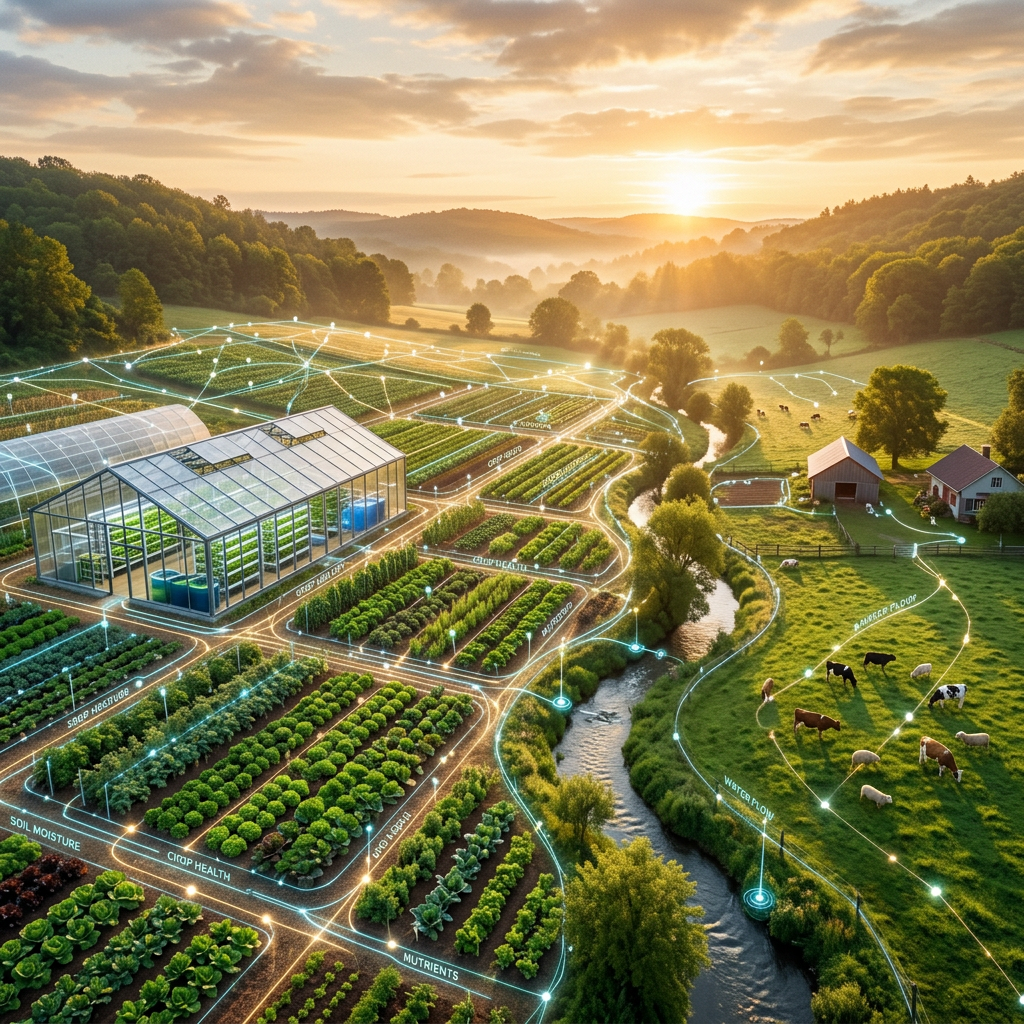
Today, AI tools can combine multispectral satellite imagery, field-level observations, and sensor data to identify changes in soil conditions much earlier. That means farmers and land managers can better detect declining organic matter, low moisture retention, and other signs of stress before the damage becomes obvious.
This matters because earlier insight leads to faster intervention. And faster intervention often means lower cost, less waste, and better outcomes.
Research published in Nature has also highlighted the role AI can play in advancing environmental solutions while supporting inclusive economic growth. That makes AI especially relevant for sustainable agriculture and education-focused organizations working at the intersection of ecology and economics.
Smarter Water Use Is Becoming One of AI’s Biggest Contributions
Water is one of the most important resources in agriculture. At the same time, it is one of the most vulnerable.
In many regions, growers are facing increasing pressure from drought, water scarcity, declining water quality, and rising production costs. Therefore, managing water well is no longer optional. It is essential.
AI is helping improve water management in two major ways.
First, it supports more precise irrigation. Instead of relying on fixed schedules, AI-assisted systems can use crop data, weather forecasts, and soil moisture information to determine when water is truly needed and how much should be applied. Because of that, water use can become more efficient, and crops can be supported more accurately.
Second, AI is improving water quality monitoring. Machine learning systems can process environmental data more quickly and flag unusual patterns that may indicate pollution, nutrient overload, or contamination. This helps reduce response time and gives communities a better chance to protect both production systems and ecosystems.
In other words, AI is not only helping people use less water. It is also helping them protect the quality of the water they depend on.
AI Is Making Sustainable Food Systems More Practical
For years, one of the biggest challenges in sustainability has been proving that environmentally sound systems can also make economic sense.
That argument is becoming easier to make.
AI strengthens sustainable food systems by improving efficiency, reducing waste, and creating better data for decision-making. On the cost side, it can reduce labor inefficiencies, limit unnecessary inputs, and improve timing. On the income side, it can help producers document outcomes more clearly, which may support access to premium markets, environmental programs, and impact-focused investment.
This is important because sustainability only scales when it also works financially.
A review published through ScienceDirect in 2024 noted that AI has significant potential to support net-zero sustainability goals, including applications in agriculture and food systems. That reinforces what many practitioners are already beginning to see: AI is becoming a business tool as much as an environmental one.
Why This Matters for Farmers, Students, and Future Agripreneurs
You do not need to be a programmer or data scientist to benefit from AI.
What matters most is understanding what these tools can do and how they can be used in the real world. Farmers can use them to make better production decisions. Students can use them to understand where agriculture is going. Agripreneurs can use them to build stronger, more resilient businesses. Educators can use them to prepare the next generation to work with smarter systems.
That is why AI belongs in the conversation about food, land, sustainability, and education.
The future of agriculture will not be shaped by tradition alone. It will also be shaped by better tools, better data, and better timing. AI is becoming one of those tools.
A Better Way to Nourish the Planet
Feeding the planet has never been just about growing more food. It has always been about growing food more wisely.
That means protecting soil. It means managing water carefully. It means reducing waste. And it means building systems that are environmentally nurturing while still being economically sustainable.
AI is helping make that possible.
It is giving farmers and land stewards better visibility. It is helping sustainable systems become more efficient. And it is making practical education around food and ecology more important than ever.
That is good news for agriculture, good news for communities, and good news for the planet.
Learn How AI Can Help You Develop Your Own Business
Want to learn how emerging tools like AI are shaping the future of food, sustainability, and regenerative enterprise?
Explore more through Nourish the Planet and the EAT Community, where we focus on practical education for building environmentally nurturing and economically sound systems.
Suggested External Links
You can hyperlink these naturally in the article:
- How Technology is Driving the Advancement of Sustainable Agriculture
- Nature article on AI and climate transition
- FAO resource on digital agriculture
- ScienceDirect review on AI and net-zero sustainability
- relevant sustainable agriculture or water management resource page on your own site
- EAT Community Website
Recent Comments