
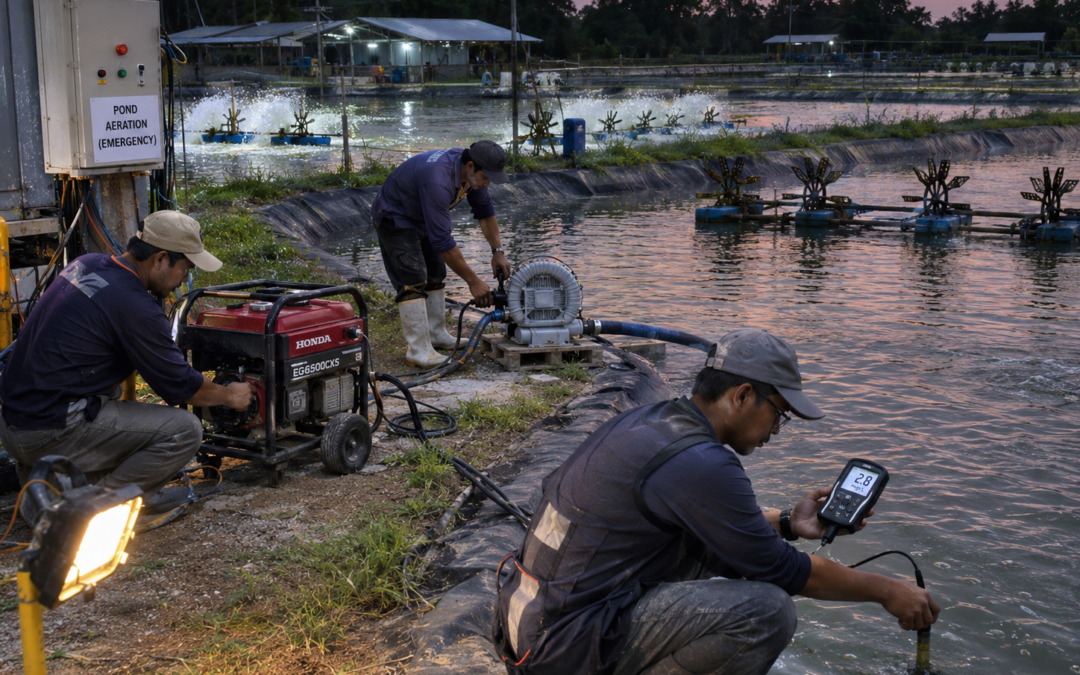
Electricity keeps many modern fish farms running. Aerators, pumps, water-circulation systems, filters, alarms, and automatic feeders may all depend on reliable power, so an outage can quickly become more than an inconvenience. In intensive ponds and tank systems, the greatest immediate risk is often declining dissolved oxygen because large numbers of fish and microorganisms continue consuming oxygen even when mechanical aeration stops.
The consequences can be substantial. Mississippi State University Extension documented a 2015 outage in which one Mississippi catfish operation estimated that it lost more than 300,000 pounds of fish after a downed power pole disabled normal aeration. The example shows why backup power and emergency procedures need to be planned before the electricity fails.
Protect Dissolved Oxygen First
Maintaining adequate dissolved oxygen should be the first priority during an outage. Oxygen demand continues even when aerators stop, and risk is greatest in heavily stocked ponds, warm water, systems with high feeding rates, and tanks where pumps provide both circulation and oxygen exchange. Fish gathering near the surface, gulping air, reducing feeding, or crowding around water inlets are warning signs that conditions may already be deteriorating.
University of Florida IFAS recommends emergency aeration whenever dissolved oxygen falls below 4 milligrams per liter or fish show signs of oxygen depletion. Its guidance notes that many farms begin aerating at concentrations between 2 and 4 mg/L, depending on the species, while concentrations below 5 mg/L may already be harmful to some fish.
A dissolved-oxygen meter is therefore one of the most useful pieces of emergency equipment on a fish farm. Measurements should be taken in the areas and depths where fish are concentrated rather than assuming that conditions are uniform across the pond. Risk can increase overnight because pond oxygen normally falls after sunset and reaches its lowest level shortly before sunrise.
Emergency aeration should be started before fish begin showing severe distress whenever possible. Mobile aerators, tractor-powered units, gasoline-powered pumps, oxygen injection, or other emergency systems may provide temporary support when the main electrical equipment is unavailable.
Build Backup Power Around Critical Equipment
A backup-power plan should begin by identifying which equipment must continue operating to keep fish alive. Hatchery pumps, blowers, recirculation pumps, oxygen systems, and pond aerators generally deserve priority over equipment that can remain offline temporarily. The generator or other backup system then needs to be sized for the actual starting and operating loads of that critical equipment.
USDA hurricane-preparation guidance for finfish producers recommends installing gas or diesel generators to operate critical hatchery facilities and supplemental pond or tank aeration. It also recommends keeping operating procedures near each generator and protecting generators and fuel storage from flooding where that risk exists.
Generators need routine testing, fuel, maintenance, and a clear startup procedure. Discovering during an outage that the battery is dead, fuel is stale, an extension cable is inadequate, or a transfer switch is unfamiliar can waste the minutes when oxygen is already declining. Farms should periodically run critical equipment from backup power rather than testing only whether the generator engine starts.
Generator placement is also a safety issue. CDC guidance says portable generators should operate outdoors and more than 20 feet from windows, doors, and vents because their exhaust contains carbon monoxide. Generators should never be operated inside enclosed or semi-enclosed work areas.
Reduce Feeding While Aeration and Circulation Are Limited
Feeding should usually be reduced or temporarily stopped when an outage disrupts aeration or water circulation. Feeding increases fish metabolism and oxygen demand, while uneaten feed and waste add organic material that microorganisms must decompose. Continuing a normal feeding schedule during low-oxygen conditions can therefore make an already unstable situation worse.
University of Florida guidance for recirculating aquaculture systems identifies overfeeding, inadequate aeration, excessive stocking, inadequate water flow, and organic buildup among contributors to dissolved oxygen concentrations below 4 mg/L. Recommended responses include improving aeration, reducing food when overfeeding contributes to the problem, increasing water flow, and correcting other causes of oxygen demand.
Feeding can resume after aeration, circulation, and water quality have stabilized, but there is little advantage in immediately returning to the full ration after a long interruption. Farmers should consider water temperature, fish behavior, dissolved oxygen, fish size, and the duration of the outage before rebuilding the feeding schedule.
Other systems also need attention. In recirculating aquaculture facilities, filtration and water movement may be as critical as direct aeration because stagnant water can quickly change oxygen, carbon dioxide, and waste concentrations. An emergency plan should therefore identify which pumps and filters must operate alongside aeration rather than treating every farm as if it were a simple earthen pond.
Plan for Longer Outages and More Resilient Energy
A farm emergency plan should assume that some outages will last longer than expected. Spare aerators, fuel reserves, extension cables, transfer equipment, oxygen cylinders where appropriate, charged batteries, and contact information for electricians or utility providers should be organized before they are needed. Responsibility should also be clear so workers know who starts generators, who monitors dissolved oxygen, and who decides when feeding stops.
Renewable energy can become part of this resilience strategy. WorldFish’s Center for Renewable Energy in Aquaculture has produced guidance for off-grid solar-powered pumping systems that can support farm equipment, including aeration systems. WorldFish is also testing and promoting solar-powered water pumping and aeration as part of climate-smart aquaculture projects.
Solar power does not automatically eliminate outage risk. The farm’s power demand, nighttime aeration requirements, solar resource, battery capacity, inverter size, and the length of expected outages all affect system design. A solar array without enough storage may provide little help during an overnight outage, so renewable systems should be sized around critical loads rather than installed only on the basis of panel capacity.
Power outages cannot always be prevented, but fish losses often depend on how well the farm is prepared to respond. Dissolved-oxygen monitoring, tested emergency aeration, properly sized backup power, temporary feed reduction, trained workers, and redundant energy options can turn an unexpected outage from a crisis into a manageable production event.
Join the EAT Community at https://www.eatcommunity.com/ to learn from experienced farmers and explore practical strategies for sustainable aquaculture and fish-farm management.
Recent Comments