
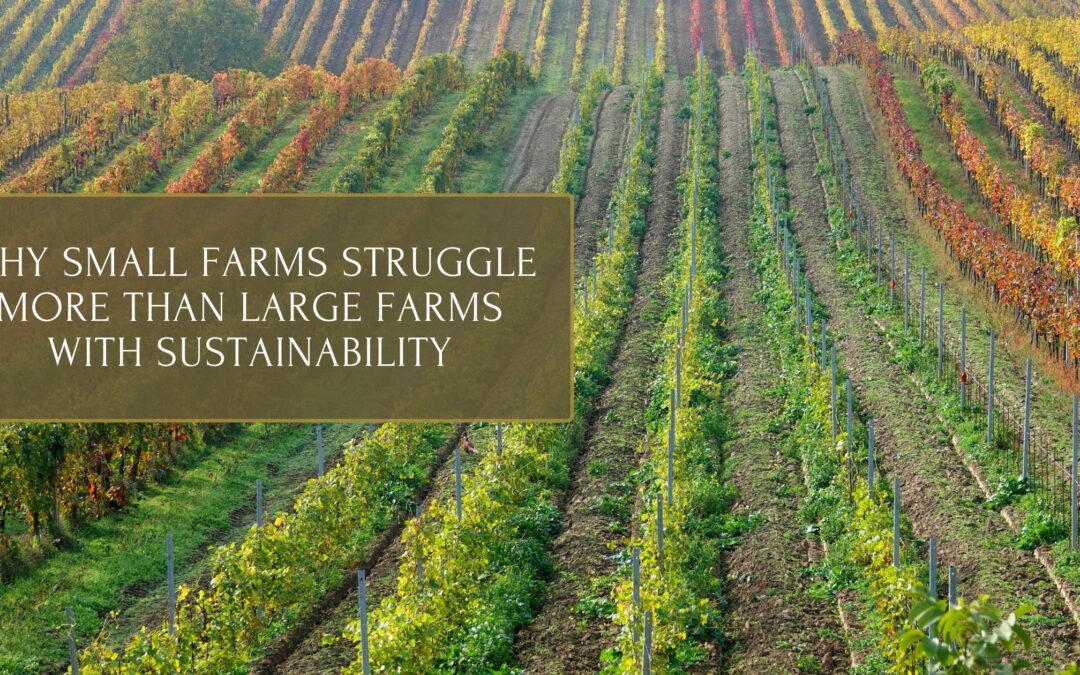
Small farms are often seen as naturally sustainable. They use less land, rely on fewer chemicals, and stay closer to local markets. Because of this, many people assume small farms automatically have an advantage when it comes to protecting the land.
However, the reality is more complicated.
Many small farms actually struggle more than large farms when it comes to long-term sustainability. The problem is not a lack of care or commitment. Instead, the challenge comes from structure, resources, markets, labor, and scale.
In other words, sustainability is not only about good intentions. It also requires investment, planning, consistency, and system design.
Limited Access to Resources
Large farms often benefit from economies of scale. They can invest in irrigation systems, soil monitoring tools, renewable energy, efficient equipment, and improved infrastructure. These investments can reduce waste, improve productivity, and support better environmental outcomes over time.
Small farms, however, usually operate with tighter budgets. As a result, they may not have the money to upgrade equipment, restore soil, improve water systems, or adopt new technology.
Access to credit is another major barrier. According to the Food and Agriculture Organization, access to finance remains an important issue for smallholder farmers, especially when they need support for long-term improvements rather than short-term survival. Without capital, small farmers may know what needs to be done but still lack the resources to do it.
For farmers who want to explore better practices, resources like the USDA’s information on farming and ranching support can be a helpful place to begin.
Higher Relative Costs
Many sustainable practices require more time, labor, and planning. Organic inputs, diversified crops, manual pest control, cover cropping, composting, and rotational systems can all be valuable. However, they can also be expensive to manage.
For large farms, these costs can be spread across hundreds or thousands of acres. For small farms, the same costs are absorbed over a much smaller production area.
Therefore, even when sustainable practices make sense in the long run, they may be difficult to afford in the short term. This creates a difficult situation for small farmers who want to protect the land but also need to survive financially.
Small farms can benefit from learning more about sustainable agriculture practices that are practical, affordable, and adaptable to smaller operations.
Market Pressures and Pricing
Small farms often face serious market disadvantages. Many do not have direct access to high-value buyers, wholesale contracts, or strong distribution networks. Instead, they may sell through intermediaries and receive lower prices for their products.
At the same time, they compete with large farms that can produce more food at lower cost.
Sustainable farming often costs more because it may involve better soil care, more labor, diversified production, and reduced dependence on cheap inputs. However, unless small farms can receive premium prices, direct customer support, or stable contracts, sustainability can become financially risky.
This is why market access matters so much. FAO notes that small family farmers face challenges tied to productivity, assets, market access, employment, poverty, food security, and migration. A small farm cannot stay sustainable if the market does not reward sustainable production.
One solution is building stronger local food systems that help connect farmers more directly with buyers, communities, and regional markets.
Labor and Time Constraints
Sustainable farming requires careful management. Farmers must pay attention to soil health, crop rotation, pest control, water use, biodiversity, animal welfare, and long-term land productivity.
That takes time.
Small farms often rely on family labor or a very small team. This limits how much planning, monitoring, and hands-on management they can realistically do. Even when farmers understand sustainable practices, they may not have enough time or help to apply them consistently.
Large farms, by comparison, may be able to hire specialists, consultants, equipment operators, or technology support. That gives them more capacity to manage complex systems.
Farmers who want to strengthen long-term productivity can begin by learning more about soil health management and applying practices that fit their scale.
Greater Exposure to Risk
Small farms are also more vulnerable to shocks. A drought, flood, pest outbreak, disease problem, equipment failure, or sudden market change can seriously damage income.
Because small farms usually have fewer financial reserves, they may be forced to focus on short-term survival. That can lead to difficult decisions, such as delaying soil improvements, reducing crop diversity, overusing land, or skipping infrastructure upgrades.
Unfortunately, these choices can weaken the farm over time.
This does not mean small farmers are careless. It means they are often operating under pressure. When survival is uncertain, long-term sustainability becomes harder to maintain.
System Design Limitations
Sustainability is not only about individual practices. It is about designing the whole farm as a working system.
Large farms often have the ability to redesign operations at scale. They can integrate water management, crop planning, soil systems, energy use, and data tracking across large areas.
Small farms may only be able to adopt isolated practices. For example, they may use compost, plant cover crops, or reduce chemical inputs. These are good steps. However, without the money, labor, and infrastructure to connect them into a complete system, the overall impact may be limited.
This is one of the biggest challenges. Sustainability works best when it is built into the entire business model, not added as a separate task.
The Real Solution
The answer is not to abandon small farms. In fact, small farms are essential to local food systems, rural communities, land stewardship, and agricultural diversity.
Small family farmers produce around one-third of the world’s food, according to FAO research. That means small farms are not a side issue. They are central to food security, rural resilience, and sustainable agriculture.
However, small farms need stronger support systems.
They need better access to markets. They need cooperative models. They need shared infrastructure, such as processing facilities, storage, equipment, distribution systems, and marketing platforms. They also need financial tools that recognize the long-term value of sustainable farming.
When small farms work together, they can gain some of the advantages of scale without losing their independence.
Conclusion
Small farms do not struggle with sustainability because they lack awareness or commitment. They struggle because sustainability requires capital, scale, labor, infrastructure, and system-level thinking.
These factors are often harder for small farms to access.
Therefore, the path forward is not simply telling small farmers to “farm more sustainably.” The real solution is to redesign the economic and support systems around them.
Sustainability is not just a farming issue. It is a structural issue.
Until those structural barriers are addressed, small farms will continue to carry a heavier burden in trying to farm sustainably.
Build a More Sustainable Farm Future
If you care about sustainable farming, now is the time to look beyond individual practices and focus on better systems. Join the EAT Community to learn practical ways to improve land health, strengthen farm businesses, and create ecolonomic solutions that make a little money while making the planet better.
Learn more by visiting EAT Community.
References and Resources
- The Essential Guide to Regenerative Agriculture: A Sustainable Future for Farming
- Food and Agriculture Organization of the United Nations — Small family farmers produce a third of the world’s food
- FAO Family Farming Knowledge Platform — Small family farmers
- FAO — Access to finance for smallholder farmers
- World Bank Open Knowledge Repository — Access to finance for smallholder farmers
- Sustainable Agriculture Research and Education — Sustainable agriculture resources
- USDA NRCS — Soil health management
Recent Comments