
Meta title: Why Some Forests Refuse to Regrow | Forest Ecology Explained
Meta description: Learn why some forests fail to return after disturbance. Explore seed loss, soil damage, invasive plants, herbivory, and microclimate shifts that block natural regeneration.
Focus keyword: Why forests refuse to regrow
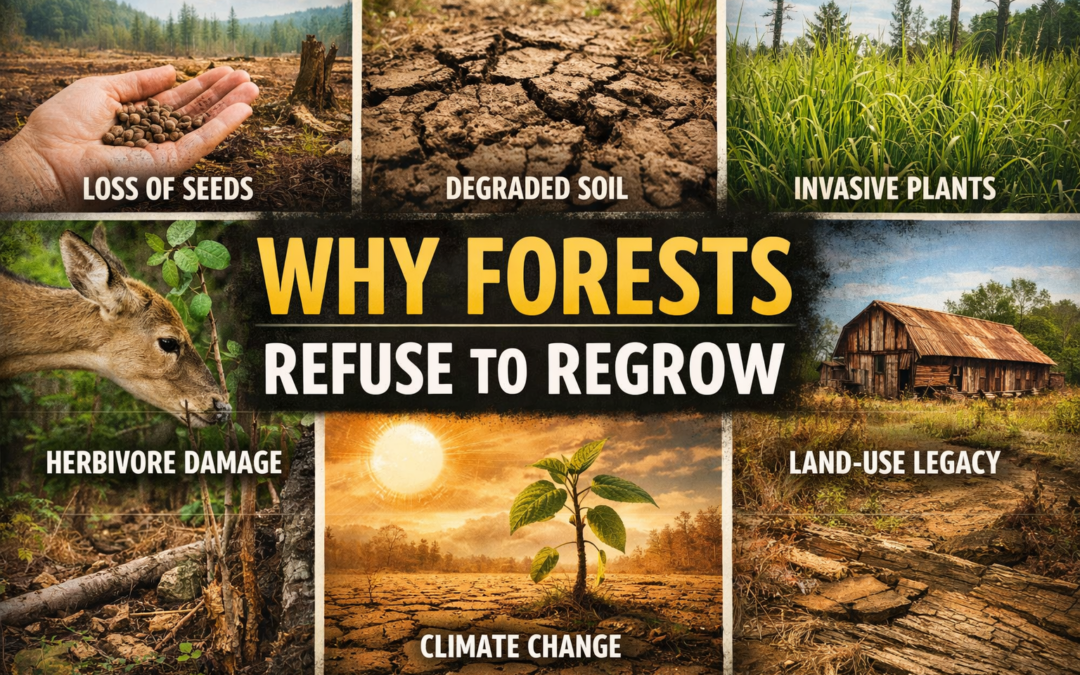
When forests are cleared, burned, or heavily disturbed, many people assume they will naturally return with time. In some places, that does happen. Seeds disperse, seedlings emerge, and a new forest slowly takes shape. However, in other landscapes, recovery stalls for years or even decades. Instead of trees returning, the land remains dominated by grasses, shrubs, or sparse vegetation. Research and restoration guidance show that this is often caused by real ecological barriers rather than simple delay.
Understanding why forests refuse to regrow is important for restoration, conservation, and land stewardship. In many cases, the solution is not just waiting longer. It is identifying the factors that are actively preventing regeneration and addressing them directly.
1. Loss of Seed Sources
One of the most important reasons forests fail to return is the lack of seeds. Natural regeneration depends on living trees nearby producing seeds that can reach the disturbed site. When large areas are cleared or remaining forest patches become isolated, the distance from seed sources can become too great for recovery to happen on its own.
This problem becomes even worse when seed-dispersing wildlife declines. Many tree species rely on birds, mammals, or other animals to move seeds across the landscape. If habitat fragmentation reduces those animal populations, seed movement slows, and tree recruitment drops with it.
For background on natural regeneration and restoration, see the FAO overview of assisted natural regeneration.
2. Soil Degradation Slows or Stops Recovery
Even when seeds arrive, they still need suitable soil conditions to germinate and survive. Disturbance can leave soils compacted, eroded, or depleted of organic matter. That makes it much harder for roots to penetrate the soil and access enough water and nutrients. FAO restoration guidance specifically identifies soil degradation as a major barrier to natural regeneration.
Forest soils also depend on living biological communities. Fungi and microorganisms help support tree growth, nutrient cycling, and root function. When forests are removed, these biological relationships can weaken, making seedling establishment even more difficult.
For a broader restoration framework, see the FAO forest restoration module.
3. Fast-Growing Grasses and Invasive Plants Take Over
Disturbed landscapes are often quickly colonized by grasses, shrubs, and invasive species. These plants grow fast, use available moisture, and compete aggressively for sunlight, nutrients, and space. In many degraded sites, this competition is strong enough to keep tree seedlings from ever establishing. FAO identifies competition with weedy species as one of the major barriers that restoration efforts must overcome.
In some cases, dense ground cover physically blocks seeds from reaching the soil. In others, invasive species dominate so thoroughly that they create a stable non-forest condition. This can trap a site in long-term ecological stagnation instead of allowing normal succession back to the forest.
4. Herbivores Can Prevent Trees From Ever Maturing
A forest can also fail to regrow even when seedlings successfully emerge. Deer, livestock, rodents, and other herbivores often browse young shoots and leaves before seedlings become established. When browsing happens repeatedly, tree populations may remain stuck in the seedling stage and never develop into a new canopy.
A 2023 global synthesis found that herbivores can strongly suppress restoration success, with especially pronounced effects at restoration sites. In parts of the eastern United States, researchers have also linked overabundant deer and invasive plants to widespread “regeneration debt,” where forests are present, but replacement trees are failing to recruit.
For a research summary on this topic, see the PubMed record for the global herbivory synthesis.
5. Microclimate Changes Make Conditions Too Harsh
When forests are removed, the local environment changes immediately. The ground receives more direct sunlight, temperatures rise, humidity drops, and wind exposure increases. These shifts can dry soils faster and create stressful conditions for young trees. Many seedlings that could survive under a partial canopy struggle in fully exposed landscapes.
In dry or heavily degraded settings, these microclimate changes can push the site beyond the tolerance range of native tree species. The result is a landscape that favors hardy grasses and shrubs over forest regeneration.
6. Land-Use History Can Keep a Site Locked in a Non-Forest State
What happened on the land before also matters. Research on forest succession shows that past land use can shape how, and whether, forests return. Repeated clearing, grazing, burning, logging, or other intensive use can leave behind ecological legacies that delay or block natural recovery.
This means two disturbed sites may look similar at first glance but recover very differently depending on their history, nearby forest cover, soil condition, and level of continuing pressure.
Why This Matters for Restoration
These barriers explain why tree planting is not always enough, and why passive recovery sometimes fails. Effective restoration often requires site-specific intervention such as protecting seed sources, reducing browsing pressure, controlling invasive species, improving soil conditions, or using assisted natural regeneration methods. FAO and IUFRO both describe restoration as a process of removing the obstacles that prevent natural forest succession from moving forward.
In other words, forests do not always come back just because disturbance ends. Sometimes the ecological system has been altered enough that it needs active help.
Conclusion
Forest regrowth is never guaranteed after trees disappear. A disturbed landscape may fail to return to forest because seeds no longer arrive, soils have been degraded, invasive plants dominate the site, herbivores consume young trees, or local climate conditions have become too harsh for seedlings to survive. In many cases, several of these pressures act together.
That is why restoration begins with diagnosis. Before land managers can bring a forest back, they must understand what is stopping it from returning in the first place.
To explore more topics in forest ecology, regeneration, and sustainable stewardship, visit EAT Community.
References
- FAO — Assisted Natural Regeneration
- FAO — Forest Restoration Module
- IUFRO — Implementing Forest Landscape Restoration: A Practitioner’s Guide
- CIFOR-ICRAF — Site-Level Rehabilitation Strategies for Degraded Forest Lands
- Jakovac et al. (2021), The role of land-use history in driving successional pathways and its implications for the restoration of tropical forests
- Xu et al. (2023), Herbivory limits the success of vegetation restoration globally
- Miller et al. (2023), Overabundant deer and invasive plants drive widespread regeneration debt in eastern United States national parks
Recent Comments